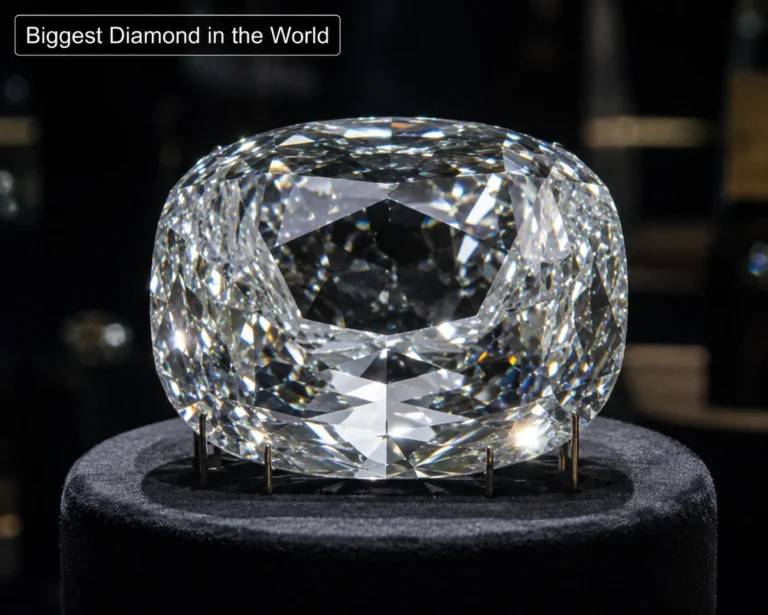
The biggest diamond in the world is the legendary Cullinan Diamond, a gemstone that has fascinated historians, jewelers, and collectors for more than a century. Discovered in South Africa in 1905, this extraordinary diamond weighed an astonishing 3,106.75 carats in its rough form, making it the largest gem-quality diamond ever found.
Even today, no other diamond has surpassed the Cullinan Diamond’s record. Its remarkable size, exceptional clarity, and fascinating history have secured its place among the most famous gemstones ever discovered. Parts of the original stone now form some of the most valuable jewels in the world and are closely associated with the British Crown Jewels.
This article explores everything you need to know about the biggest diamond in the world, including its discovery, characteristics, cutting process, value, and enduring legacy.
What Is the Biggest Diamond in the World?
The Cullinan biggest diamond in the worldholds the title of the largest gem-quality rough diamond ever discovered. When it was unearthed in South Africa, it weighed 3,106.75 carats, equivalent to approximately 621 grams or 1.37 pounds.
The diamond’s sheer size stunned experts and quickly became international news. Unlike many large diamonds that contain significant flaws, the Cullinan Diamond possessed exceptional clarity and quality, making it one of the most remarkable gemstone discoveries in history.
Its record has stood for more than a century,biggest diamond in the world, highlighting just how rare such a discovery truly is.
Understanding the Size of the Cullinan Diamond
To appreciate the scale of the Cullinan Diamond,biggest diamond in the world, it helps to compare it with other famous gemstones. Most diamonds used in engagement rings weigh between one and three carats. The Cullinan Diamond weighed more than three thousand carats before being cut.
The stone was roughly the size of a human fist and reflected light brilliantly even in its rough state. Experts believed it represented only a fragment of a much larger crystal that may have broken apart naturally deep within the Earth millions of years ago.
Why It Was Considered Extraordinary
Large diamonds are rare, but large diamonds of exceptional quality are even rarer. The Cullinan Diamond stood out because of its transparency, color, and structural integrity.
Its combination of size and quality made it suitable for cutting into multiple world-famous gemstones rather than being used for industrial purposes. This unique characteristic significantly increased its historical importance and value.
Discovery of the Cullinan Diamond
The discovery of the Cullinan Diamond remains one of the most famous moments in mining history.
Found in South Africa
The diamond was discovered on January 26, 1905,biggest diamond in the world at the Premier Mine near Pretoria, South Africa. The mine would later become known as the Cullinan Mine in honor of the historic find.
At the time, South Africa was already recognized as one of the world’s leading diamond-producing regions. However, no one expected a diamond of such enormous size to emerge from the mine.
The Man Who Found It
The discovery is credited to Frederick Wells, the mine’s superintendent. During a routine inspection, Wells noticed a flash of light reflecting from the mine wall.
Initially, he suspected it was a piece of glass. After carefully removing it from the rock facebiggest diamond in the world , he realized he had uncovered something extraordinary. The stone was quickly authenticated as a genuine diamond.
Global Attention
News of the discovery spread rapidly across the world. Newspapers described the diamond as one of the greatest mineral discoveries ever made.
Governments, jewelers, collectors, and royal families all took an interest in the giant gemstone. It became a symbol of the extraordinary treasures hidden beneath the Earth’s surface.
How the Cullinan Diamond Got Its Name
The biggest diamond in the world was named after Thomas Cullinan, the owner of the Premier Mine where it was discovered.
Cullinan was a successful businessman who had invested heavily in diamond mining operations. The decision to name the diamond after him helped cement both his legacy and the mine’s place in history.
Today, the name Cullinan is recognized worldwide and remains synonymous with one of the greatest gemstone discoveries ever made.
The Journey to Royal Ownership
After its discovery, the diamond became the subject of intense public interest.
Purchase by the Transvaal Government
In 1907, the Transvaal government purchased the Cullinan Diamond and presented it to King Edward VII of the United Kingdom as a birthday gift.
The gift was intended to strengthen political ties between Britain and South Africa during a period of rebuilding following the Boer War.
Transportation and Security
Transporting one of the world’s most valuable diamonds posed a significant challenge. Elaborate security arrangements were organized to protect the gemstone during its journey to Europe.
Interestingly, much of the security operation served as a distraction. While decoy packages attracted attention, the real diamond reportedly traveled through a less conspicuous route.
Arrival in Europe
Once safely delivered, the diamond was presented to King Edward VII. The next challenge involved deciding how to cut such a valuable and historically significant gemstone.
Cutting the World’s Largest Diamond
The task of cutting the Cullinan Diamond was entrusted to the famous Asscher Diamond Company in Amsterdam.
A Difficult Challenge
Cutting a diamond of this size required months of preparation and study. Experts carefully examined the crystal structure to determine the safest points for splitting the stone.
One mistake could have shattered the diamond and destroyed a priceless natural treasure.
The Historic Split
The cutting process became famous for the precision involved. After extensive planning, the diamond was successfully split along a natural cleavage line.
The operation marked one of the greatest achievements in gem-cutting history.
Creating Multiple Gemstones
Rather than producing a single polished diamond, the Cullinan Diamond was cut into several major stones and many smaller gems.
This decision allowed more of the original material to be preserved and showcased.
The Famous Cullinan Diamonds
The original rough diamond produced nine major diamonds and nearly one hundred smaller stones.
Cullinan I: The Great Star of Africa
The largest gem produced from the original stone is Cullinan I, also known as the Great Star of Africa.
Weighing 530.2 carats, it remains one of the largest clear-cut diamonds in existence. It is mounted in the Sovereign’s Sceptre and forms part of the British Crown Jewels.
The Great Star of Africa is widely regarded as one of the most valuable gemstones ever cut.
Cullinan II: The Second Star of Africa
The second-largest gem, Cullinan II, weighs 317.4 carats.
This remarkable stone is mounted in the Imperial State Crown and is another important component of the British Crown Jewels.
Its brilliance and historical significance make it one of the most recognizable diamonds in the world.
The Remaining Cullinan Stones
The remaining major diamonds are known as Cullinan III through Cullinan IX.
Together, these stones represent one of the most successful and celebrated cutting projects in gemstone history. Several remain in royal collections and continue to attract public interest.
How Valuable Is the Cullinan Diamond?
Determining the value of the Cullinan Diamond is extremely difficult.
Historical Significance
Unlike ordinary gemstones, the Cullinan Diamond carries immense historical importance. Its association with royalty, mining history, and gem-cutting innovation significantly increases its worth.
As a result, traditional valuation methods cannot fully capture its true value.
Modern Estimates
Experts believe that if the original rough diamond were discovered today, it could potentially be worth hundreds of millions of dollars.
The combined value of all major Cullinan stones would likely reach into the billions because of their rarity and global significance.
Considered Priceless
Many gemologists consider the Cullinan Diamond essentially priceless. Few natural treasures can match its combination of size, quality, and historical importance.
Other Massive biggest diamond in the worldin History
Although the Cullinan Diamond remains the largest gem-quality rough diamond ever discovered, several other diamonds deserve recognition.
Lesedi La Rona
Discovered in Botswana in 2015, Lesedi La Rona weighed 1,109 carats in its rough form.
It became one of the largest diamond discoveries of modern times but remained significantly smaller than the Cullinan Diamond.
Excelsior Diamond
Before the Cullinan Diamond’s discovery, the Excelsior Diamond held the record for size.
Found in South Africa in 1893, it weighed 995.2 carats and was considered extraordinary for its time.
Golden Jubilee Diamond
The Golden Jubilee Diamond holds the distinction of being the largest faceted diamond currently in existence.
After cutting and polishing, it weighed 545.67 carats and became one of the world’s most celebrated gemstones.
Where Is the Biggest Diamond Today?
The largest pieces of the Cullinan Diamond remain part of the British Crown Jewels.
Displayed at the Tower of London
Visitors can view the Crown Jewels at the Tower of London, where the most famous Cullinan stones are displayed.
Millions of tourists visit every year to see these historic treasures.
Role in Royal Ceremonies
Several Cullinan diamonds continue to appear during important royal ceremonies and state events.
Their ongoing use reflects their significance within British royal history.
A Global Attraction
More than a century after its discovery, the Cullinan Diamond continues to attract worldwide attention.
Its story remains one of the most remarkable chapters in gemstone history.
Why the Cullinan Diamond Still Fascinates the World
The biggest diamond in the world remains unmatched because it combines extraordinary size, exceptional quality, and historical significance.
Few natural discoveries have captured global attention in the same way. The diamond symbolizes both the wonders of nature and the skill of human craftsmanship.
Its journey from a South African mine to the world’s most famous royal collection continues to inspire fascination among historians, gemologists, and jewelry enthusiasts alike.
Frequently Asked Questions
What is the biggest diamond in the world?
The biggest diamond in the world is the biggest gem-quality rough diamond ever discovered. It weighed 3,106.75 carats when found in South Africa in 1905.
How much does the Cullinan Diamond weigh?
The rough Cullinan Diamond weighed 3,106.75 carats, equivalent to approximately 621 grams.
Where was the biggest diamond in the world discovered?
It was discovered at the Premier Mine near Pretoria, South Africa, on January 26, 1905.
What happened to the Cullinan Diamond?
The original biggest diamond in the worldwas cut into nine major gemstones and numerous smaller stones. The largest pieces became part of the British Crown Jewels.
Can the Cullinan Diamond be purchased?
No. The most famous biggest diamond in the world are part of royal collections and are considered priceless historical treasures.
Conclusion
The biggest diamond in the world remains the undisputed biggest diamond in the world and one of the most remarkable gemstones ever discovered. Found in South Africa in 1905, its record-breaking size of 3,106.75 carats has never been surpassed by another gem-quality rough diamond.
Beyond its enormous size, thebiggest diamond in the world exceptional quality, fascinating history, and connection to royalty have made it a global icon. More than a century after its discovery, it continues to captivate people around the world and stands as a lasting symbol of nature’s extraordinary ability to create wonders beneath the Earth’s surface.